500.7 nmDeep space, Voyager 1
One light-day.
On 18 November 2026, Voyager 1 will be so far from Earth that light, and every radio signal, takes a whole day to cross the gap. Nothing people have built has ever been this far away.
Written with AI from the sources listed
Voyager 1 reaches one light-day from Earth in
By NASA's figure, it crosses the line at
Malta time: Europe/MaltaWed 18 Nov 2026, 10:16:07 UTC
Where it is right now
Measured from the centre of the Earth by NASA/JPL Horizons, and moved on each second.
- From Earth, right now
- 25,793,783,757km
- Time for light to get there
- 23 hours 53 minutes 59 seconds
- In astronomical units
- 172.421au
- One au is about the average distance between Earth and the Sun.
- Share of one light-day
- 99.58%
Moving away from Earth at 37.64 km/s. That speed includes Earth's own motion around the Sun, so it rises and falls through the year.
Updated Data: NASA/JPL
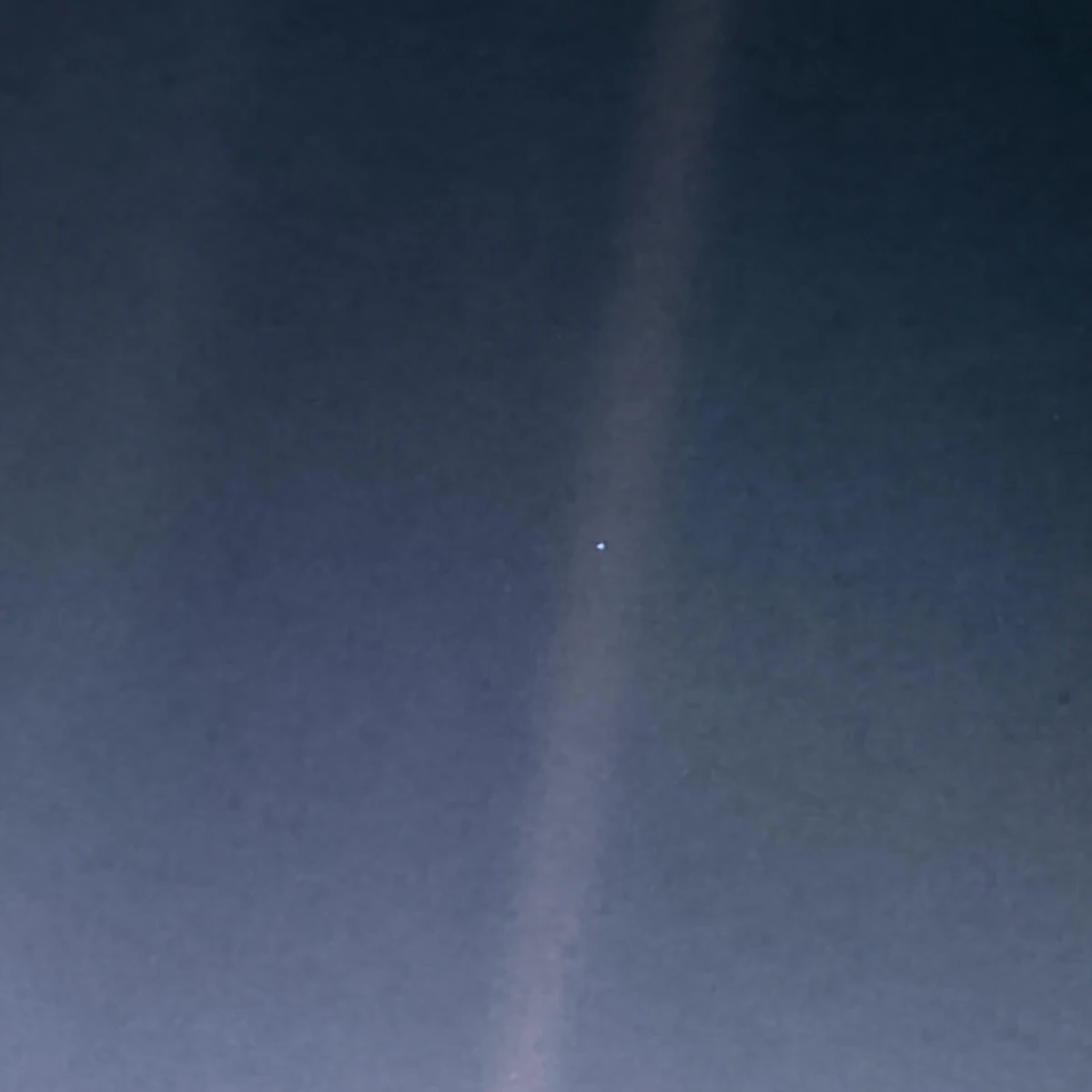
Earth from about 6 billion km: Voyager 1's view of 14 Feb 1990, reprocessed by NASA/JPL in 2020. False colour; the bands are sunlight scattered in the camera.
Credit: NASA/JPL-Caltech · JPL Image Use Policy · SourceHome, from 6 billion km.
On 14 February 1990, 34 minutes before its cameras were switched off for good, Voyager 1 looked back and photographed Earth. From about 6 billion km away, our planet was a single point of light, caught in a band of sunlight scattered inside the camera.
Voyager 1 is now more than four times further away, and the light that left Earth when you opened this page is still on its way to it.
What a light-day is
Light crosses 299,792.458 km every second. A day has 86,400 seconds, so in one day light covers about 25.9 billion km (25,902,068,371 km). That distance is a light-day: about 173 times the distance from Earth to the Sun.
Radio waves travel at the speed of light too. Once Voyager 1 is a light-day away, a command sent from Earth takes a day to reach it, and its reply takes another day to come back.
- The Moonabout 1.3 seconds
- The Sunabout 8 minutes 19 seconds
- Mars3 to 22 minutes
- Voyager 1, on 18 Novone whole day
49 years on the way
From launch to one light-day: 49 years, two months and 11 days, as NASA counts it.
It looks back and sees Earth as a pale blue dot
About 6 billion km out, 34 minutes before its cameras were switched off for good.
The most distant object people have ever made
It passed NASA's Pioneer 10 to take the record.
Source: Voyager 1 (NASA Science)
It leaves the heliosphere for interstellar space
The first spacecraft to leave the heliosphere, the bubble the Sun's wind blows around the planets.
Source: NASA Spacecraft Embarks on Historic Journey Into Interstellar Space (NASA JPL)
One light-day from Earth
At 10:16:07 UTC, by NASA's figure. Light from Earth then takes a full day to reach it.
How we measure it
The countdown runs to the moment NASA published: . It matches the straight-line distance between the centres of Earth and Voyager 1 reaching one light-day at that instant, which we checked against NASA/JPL Horizons.
The live figures above are measured a little differently: by the light now reaching the centre of the Earth, which left Voyager 1 a day earlier, when it was about 1.5 million km closer. By that measure the light-time reaches a full day about 16 hours later, at .
Both are honest answers to slightly different questions. We show NASA's moment and never move either one to match the other. Every distance here is from the centre of the Earth: at Voyager 1's speed, one Earth radius would move the crossing by about four minutes.