MRV-1
Falcon 9 Block 5, SpaceX
Space Launch Complex 40, Cape Canaveral SFS, FL, USA
Launch time
Window opens
Tue 21 Jul, 23:15 CEST
21:15 UTC
The rocket put its payload into the planned orbit.
- Window closes
How sure is this date?
The source gives minute precision. Launch plans can change.
Launch probability 90%
Weather concerns: Cumulus Cloud Rule, Anvil Cloud Rules
Source updated
UpdatedSlip history
No changes since we started tracking on .
- LL2 update
Launch success.
Read the source update - LL2 update
All spacecraft have separated.
Read the source update - LL2 update
Unofficial Re-stream by SPACE AFFAIRS has started
Read the source update - LL2 update
Liftoff.
Read the source update - LL2 update
Unofficial Re-stream by SPACE AFFAIRS has started
Read the source update - LL2 update
Updated launch weather, 75% GO.
Read the source update - LL2 update
Tweaked launch window.
Read the source update - LL2 update
Launch date and time confirmed.
Read the source update
Show 8 older entries
- LL2 update
Refined launch window.
Read the source update - LL2 update
NET July 21, TBC.
Read the source update - LL2 update
NET July.
Read the source update - LL2 update
NET summer.
Read the source update - LL2 update
NET Q2.
Read the source update - LL2 update
NET early 2026.
Read the source update - LL2 update
NET 2026.
Read the source update - LL2 update
Launch delayed to Q1 2025
Read the source update
Mission
MRV-1 on Falcon 9 Block 5 from Space Launch Complex 40. Launch time, status and recorded date changes from Launch Library 2.
The Northrop Grumman/SpaceLogistics MRV-1 is a mission extension payload including a mission robotic vehicle (MRV) and multiple mission extension pods (MEPs). The MRV is designed to attach up to 30 MEPs (Mission Extension Pods) to various satellites in GEO over the course of its life, and the MEPs (Mission Extension Pods) are 400 kg spacecraft designed to be captured by the MRV and then attached to a customer's satellite. A single MEP can extend a 2000 kg satellite's service life by up to 6 years. For this mission, 2 of the MEP's will service satellites for Intelsat, while the third will service a satellite for Optus.
- Mission type
- Mission Extension
- Orbit
- Geostationary Transfer Orbit
Rocket file imagery
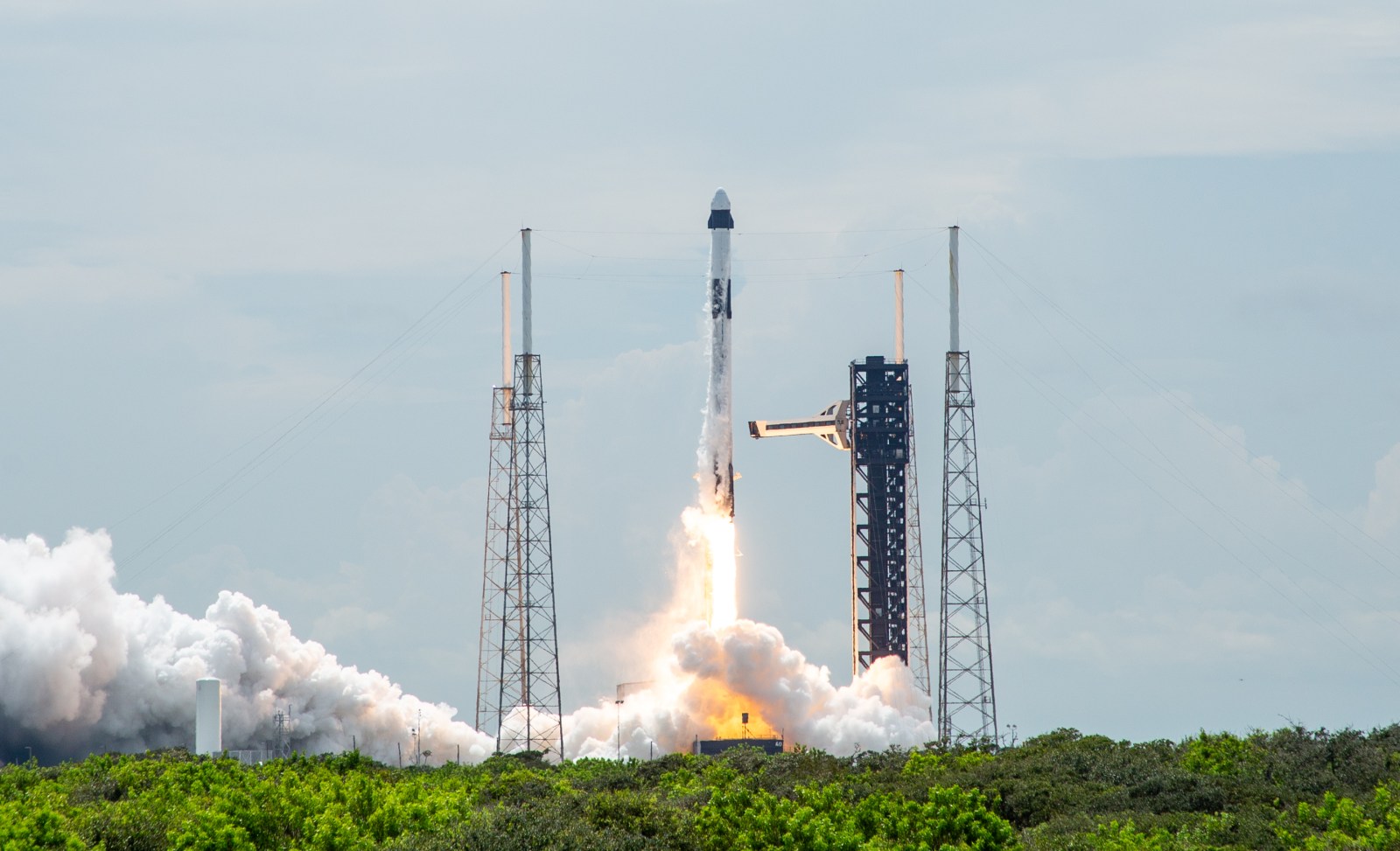
File imagery: Crew-9, 28 September 2024. Falcon 9 lifting off from Space Launch Complex 40.
Credit: NASA/Keegan Barber · Public domain (NASA) · SourceMission patches
- MEP MRV NG
Patch artwork is not shown because its image licence is unconfirmed.
Launch timeline
Times are relative to liftoff. Clock times are not shown while T-0 is unconfirmed or on hold.
- T-38 min
GO for Prop Load
Launch director verifies go for propellant load
- T-35 min
Stage 1 LOX Load
Start of liquid oxygen loading in the first stage
- T-35 min
Prop Load
Start of propelland loading
- T-16 min
Stage 2 LOX Load
Start of liquid oxygen loading in the second stage
- T-7 min
Engine Chill
Start of engine chilling
- T-1 min
Startup
The onboard computer takes control over the countdown and runs last checks
- T-1 min
Tank Press
Fuel tanks are pressurized to flight levels
- T-45 s
GO for Launch
Launch director verifies go for launch
- T-3 s
Ignition
Start of the engine ignition sequence
- T-0
Liftoff
First upwards movement of the rocket
- T+1 min 12 s
Max-Q
Maximum dynamic pressure
- T+2 min 37 s
MECO
Cut-off of the main engine
- T+2 min 41 s
Stage 2 Separation
Separation of the second stage from the first
- T+2 min 48 s
SES-1
First start of the second engine
- T+3 min 29 s
Fairing Separation
Separation of the payload fairing
- T+7 min 55 s
SECO-1
First cut-off of the second engine
- T+29 min
SES-2
Second start of the second engine
- T+30 min 5 s
SECO-2
Second cut-off of the second engine
- T+35 min 34 s
Payload Separation
Final deployment of the payload from the rocket
- T+45 min 34 s
Payload Separation
Final deployment of the payload from the rocket
- T+55 min 34 s
Payload Separation
Final deployment of the payload from the rocket
- T+56 min 51 s
SECO-2
Second cut-off of the second engine
- T+1 h 5 min 34 s
Payload Separation
Final deployment of the payload from the rocket
Launch pad
Space Launch Complex 40
Cape Canaveral SFS, FL, USA (US)
Coordinates: 28.56194122, -80.57735736
View launch pad on a map