Dragonfly
Falcon Heavy, SpaceX
Launch Complex 39A, Kennedy Space Center, FL, USA
Launch time
No earlier than
NET Wed 5 Jul 2028
Current date is a placeholder or rough estimation based on unreliable or interpreted sources.
How sure is this date?
The source gives day precision. Launch plans can change.
Source updated
UpdatedSlip history
No changes since we started tracking on .
- LL2 update
Added launch.
Read the source update
Mission
Dragonfly on Falcon Heavy from Launch Complex 39A. Launch time, status and recorded date changes from Launch Library 2.
Dragonfly is NASA's 4th New Frontiers program mission that will send a robotic rotorcraft to fly within the atmosphere of Saturn's moon Titan to sample materials and determine surface composition in different geologic settings, advancing humanity's search for the building blocks of life. The craft is a large quadcopter with double rotors with mass of about 875 kg, featuring rotors of 1.35 m in diameter. It can fly through several kilometers within an hour and will perform 1 flight per Titan day (~16 Earth days). During the planned 3.3-year mission, Dragonfly is expected to cover distance up to several hundred km. Dragonfly will use a Multi-Mission Radioisotope Thermoelectric Generator (MMRTG) to power its instruments. The planned science instrument suite is: * DragonCam: Camera Suite * DrACO: Drill for Acquisition of Complex Organics * DraMS: Mass Spectrometer * DraGNS: Gamma-ray and Neutron Spectrometer * DraGMet: Geophysics and Meteorology
- Mission type
- Planetary Science
- Orbit
- Heliocentric N/A
Rocket file imagery
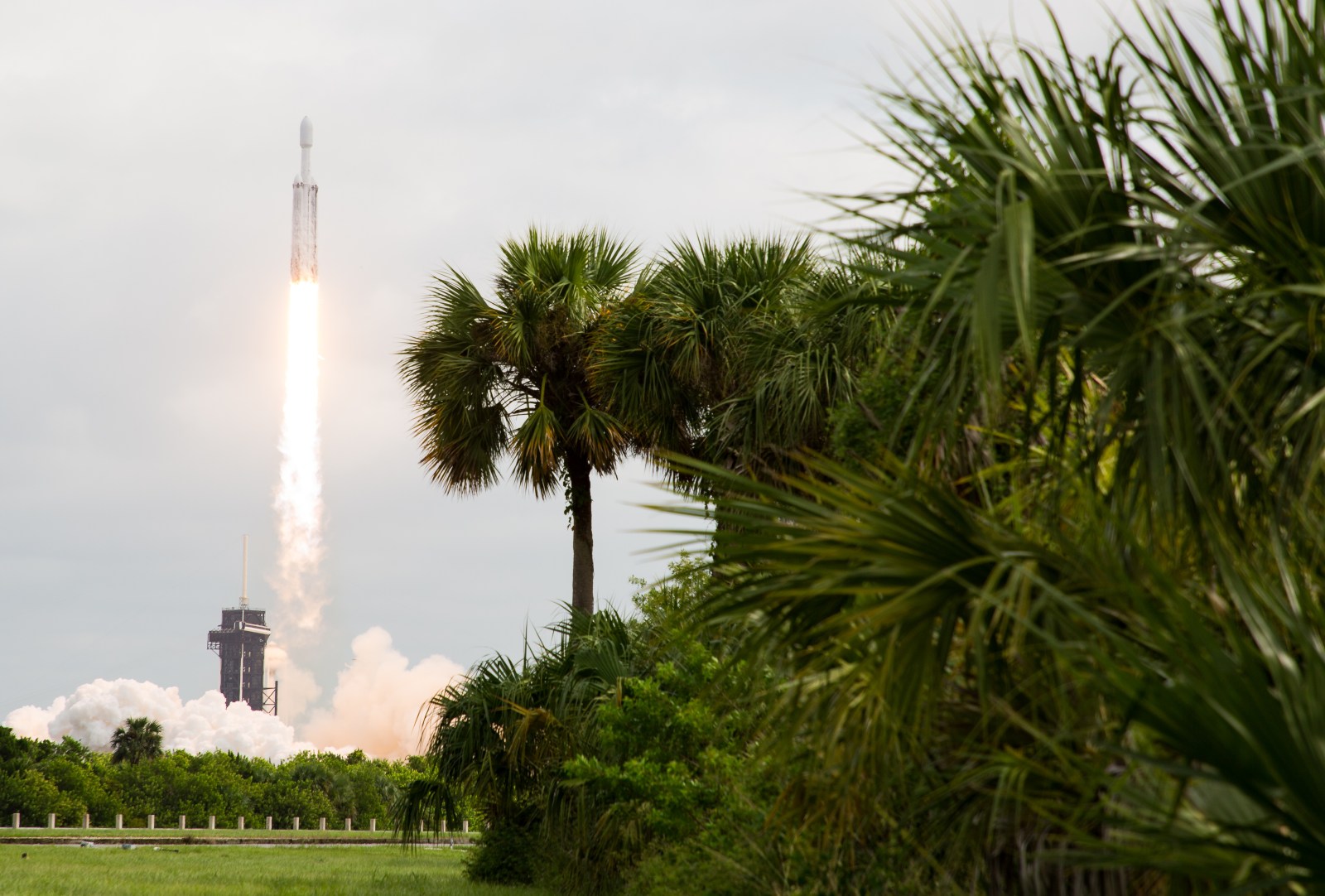
File imagery: Psyche, 13 October 2023. Falcon Heavy lifting off from Launch Complex 39A.
Credit: NASA/Aubrey Gemignani · Public domain (NASA) · SourceLaunch timeline
No timeline has been provided by the source.
Launch pad
Launch Complex 39A
Kennedy Space Center, FL, USA (US)
Coordinates: 28.60822681, -80.60428186
View launch pad on a map