Nancy Grace Roman Space Telescope
Falcon Heavy, SpaceX
Launch Complex 39A, Kennedy Space Center, FL, USA
Launch time
T-0
Sun 30 Aug, 13:26:04 CEST
11:26:04 UTC
The rocket put its payload into the planned orbit.
- Window opens
- Window closes
How sure is this date?
The source gives second precision. Launch plans can change.
Launch probability 70%
Weather concerns: Cumulus Cloud Rule, Surface Electric Fields Rule
Source updated
UpdatedSlip history
No changes since we started tracking on .
- LL2 update
Launch success with telescope solar panels/sunshade deployed.
Read the source update - LL2 update
Payload deployed.
Read the source update - LL2 update
Liftoff!
Read the source update - LL2 update
Updated launch weather, 70% GO.
Read the source update - LL2 update
Official Webcast by NASA has started
Read the source update - LL2 update
Now targeting Aug 30 at 11:26 UTC
Read the source update - LL2 update
Updated launch weather, 50% GO (launch window per https://x.com/spaceflightnow/status/2093717878302216462).
Read the source update - LL2 update
Now targeting Aug 30 at 11:25 UTC
Read the source update
Show 11 older entries
- LL2 update
Updated launch weather, 60% GO.
Read the source update - LL2 update
GO for launch.
Read the source update - LL2 update
Tweaked T-0.
Read the source update - LL2 update
Setting GO.
Read the source update - LL2 update
Added tentative launch time.
Read the source update - LL2 update
NET August 30.
Read the source update - LL2 update
NET late August.
Read the source update - LL2 update
May move up to NET early September.
Read the source update - LL2 update
NET September 28.
Read the source update - LL2 update
NET September.
Read the source update - LL2 update
Adding launch NET October 2026
Read the source update
Mission
Nancy Grace Roman Space Telescope on Falcon Heavy from Launch Complex 39A. Launch time, status and recorded date changes from Launch Library 2.
The Nancy Grace Roman Space Telescope is a NASA infrared space telescope with a 2.4 m (7.9 ft) wide field of view primary mirror and two scientific instruments. The Wide-Field Instrument (WFI) is a 300.8-megapixel multi-band visible and near-infrared camera, providing a sharpness of images comparable to that achieved by the Hubble Space Telescope over a 0.28 square degree field of view, 100 times larger than imaging cameras on the Hubble. The Coronagraphic Instrument (CGI) is a high-contrast, small field of view camera and spectrometer covering visible and near-infrared wavelengths using novel starlight-suppression technology. Roman objectives include a search for extra-solar planets using gravitational microlensing, and probing the expansion history of the Universe and the growth of cosmic structure, with the goal of measuring the effects of dark energy, the consistency of general relativity, and the curvature of spacetime.
- Mission type
- Astrophysics
- Orbit
- Sun-Earth L2
Rocket file imagery
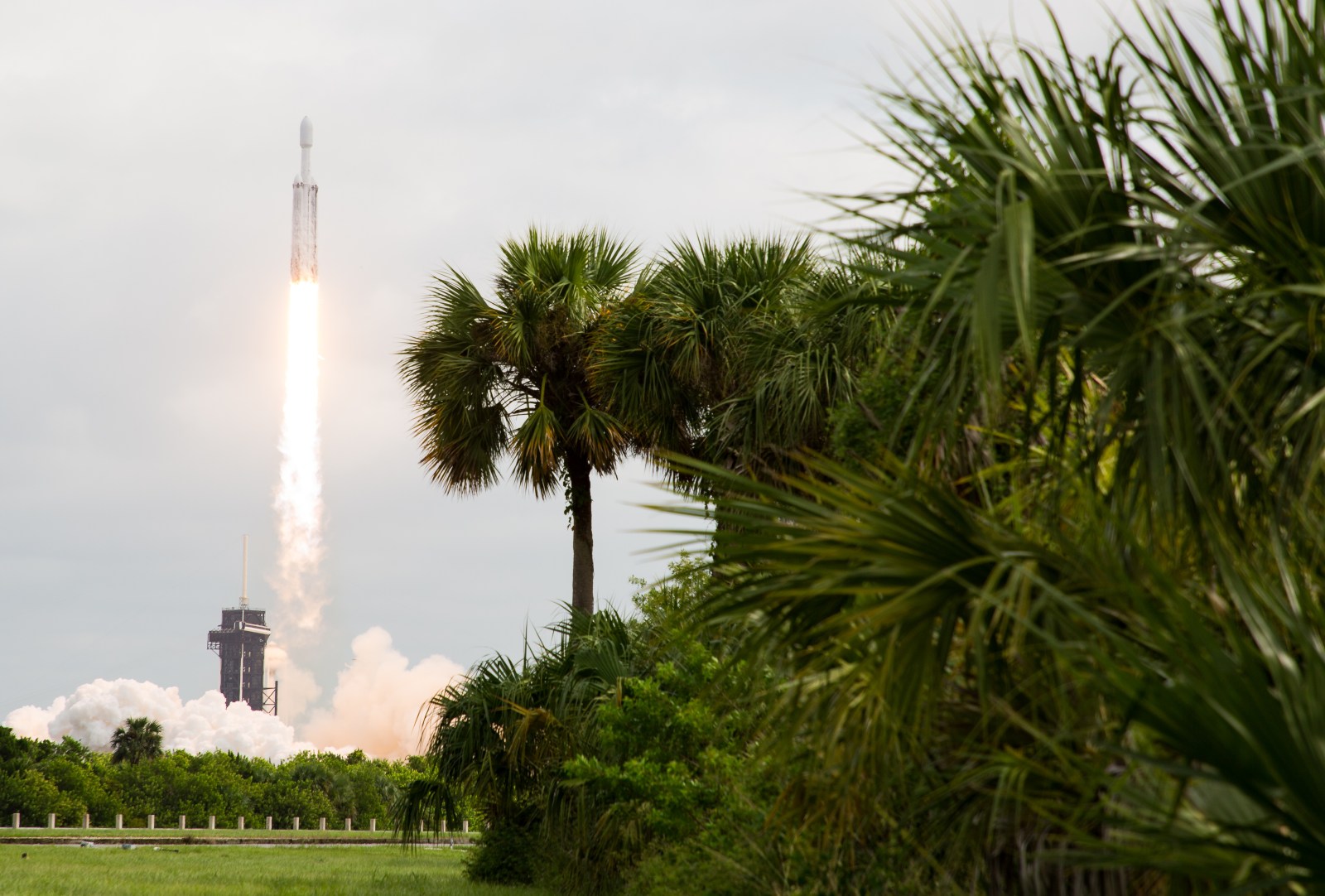
File imagery: Psyche, 13 October 2023. Falcon Heavy lifting off from Launch Complex 39A.
Credit: NASA/Aubrey Gemignani · Public domain (NASA) · SourceMission patches
- Roman
Patch artwork is not shown because its image licence is unconfirmed.
Launch timeline
Times are relative to liftoff.
- T-53 min
GO for Prop Load
Launch director verifies go for propellant load
- T-50 min
Stage 1 Propellant Load
Start of propellant loading in the first stage
- T-45 min
Stage 1 LOX Load
Start of liquid oxygen loading in the first stage
- T-35 min
Stage 2 Propellant Load
Start of propellant loading in the second stage
- T-18 min 30 s
Stage 2 LOX Load
Start of liquid oxygen loading in the second stage
- T-7 min
Engine Chill
Start of engine chilling
- T-59 s
Startup
The onboard computer takes control over the countdown and runs last checks
- T-45 s
GO for Launch
Launch director verifies go for launch
- T-20 s
Tank Press
Fuel tanks are pressurized to flight levels
- T-6 s
Ignition
Start of the engine ignition sequence
- T-0
Liftoff
First upwards movement of the rocket
- T+1 min 8 s
Max-Q
Maximum dynamic pressure
- T+2 min 24 s
SBECO
Cut-off of the side boosters
- T+2 min 27 s
Boosters Separation
Separation of the side boosters
- T+2 min 32 s
Boosters Flip
Flip maneuver of the side boosters
- T+2 min 43 s
Boosters Boostback Burn Startup
Start of the boosters boostback burn
- T+3 min 48 s
Boosters Boostback Burn Shutdown
End of the boosters boostback burn
- T+3 min 51 s
MECO
Cut-off of the main engine
- T+3 min 54 s
Stage 2 Separation
Separation of the second stage from the first
- T+4 min
SES-1
First start of the second engine
- T+4 min 15 s
Fairing Separation
Separation of the payload fairing
- T+6 min 19 s
Boosters Entry Burn Startup
Start of the boosters atmospheric entry burn
- T+6 min 29 s
Boosters Entry Burn Shutdown
End of the boosters atmospheric entry burn
- T+7 min 23 s
Boosters Landing Burn
Start of the boosters landing burn
- T+7 min 40 s
Boosters Landing
Landing of the boosters
- T+8 min 28 s
SECO-1
First cut-off of the second engine
- T+24 min 33 s
SES-2
Second start of the second engine
- T+26 min 32 s
SECO-2
Second cut-off of the second engine
- T+31 min 31 s
Payload Separation
Final deployment of the payload from the rocket
Launch pad
Launch Complex 39A
Kennedy Space Center, FL, USA (US)
Coordinates: 28.60822681, -80.60428186
View launch pad on a map