Amazon Leo (LA-06)
Atlas V 551, United Launch Alliance
Space Launch Complex 41, Cape Canaveral SFS, FL, USA
Launch time
T-0
Tue 28 Apr, 02:53:30 CEST
00:53:30 UTC
The rocket put its payload into the planned orbit.
- Window opens
- Window closes
How sure is this date?
The source gives second precision. Launch plans can change.
Launch probability 80%
Weather concerns: Cumulus Cloud Rule
Launch record updated by LL2
Feed checkedMission
Amazon Leo (LA-06) on Atlas V 551. Tue 28 Apr 2026, 00:53:30 UTC. Reported outcome: Success. Launch site: Space Launch Complex 41. Source: Launch Library 2.
Amazon Leo, formerly known as Project Kuiper, is a mega constellation of satellites in Low Earth Orbit that will offer broadband internet access, this constellation will be managed by Kuiper Systems LLC, a subsidiary of Amazon. This constellation is planned to be composed of 3,276 satellites. The satellites are projected to be placed in 98 orbital planes in three orbital layers, one at 590 km, 610 km and 630 km altitude. 29 satellites are carried on this launch.
- Mission type
- Communications
- Orbit
- Low Earth Orbit
Programmes: Amazon Leo
Launch-site file imagery
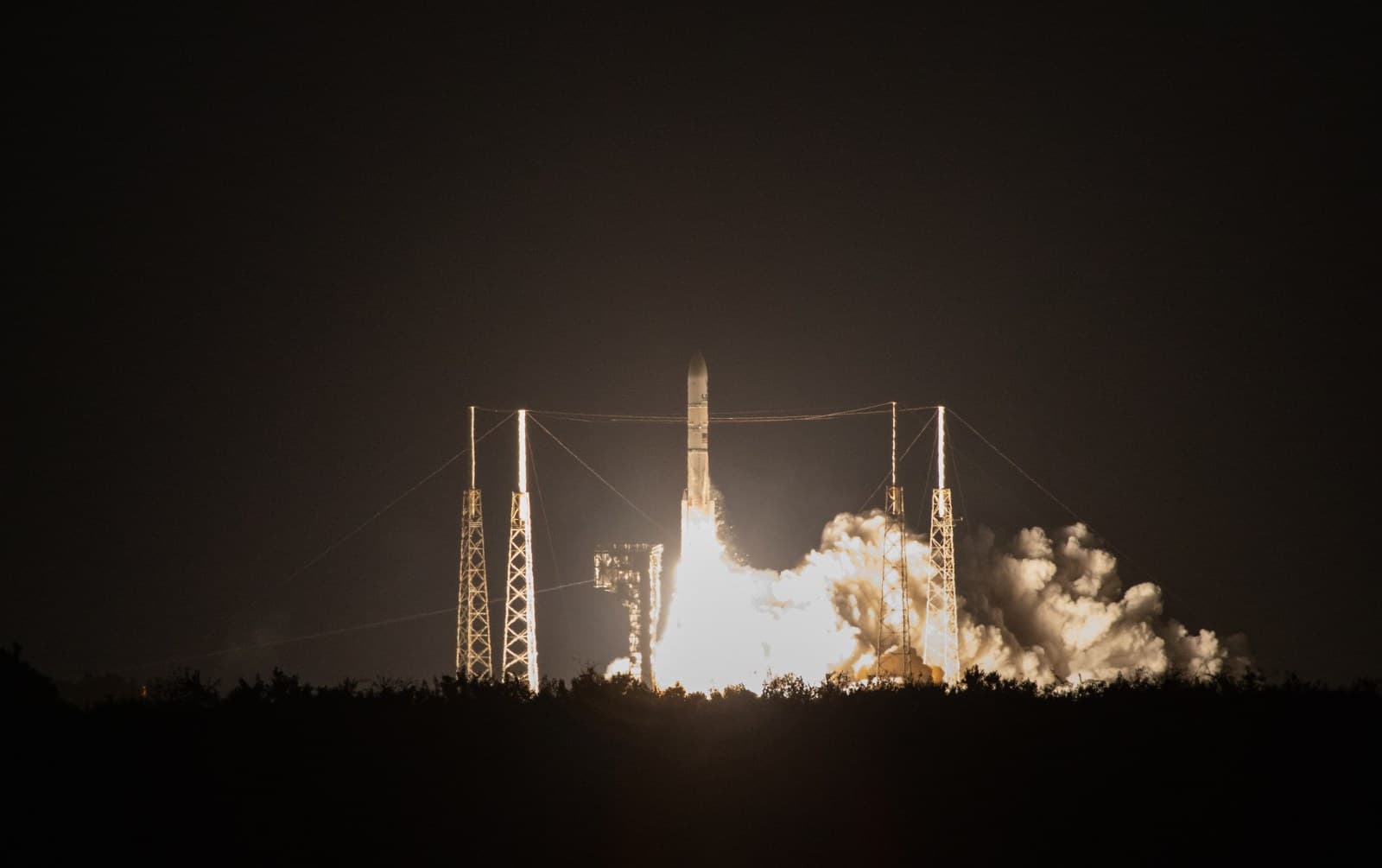
File imagery: Peregrine Mission One, 8 January 2024. Space Launch Complex 41 during a Vulcan launch.
Credit: NASA/Kim Shiflett · Public domain (NASA) · SourceLaunch timeline
Times are relative to liftoff.
- T-2.7 s
Ignition
Start of the engine ignition sequence
- T+1 s
Liftoff
First upwards movement of the rocket
- T+34.9 s
Supersonic
Vehicle is supersonic
- T+52.8 s
Max-Q
Maximum dynamic pressure
- T+1 min 46.6 s
Boosters Separation
Separation of the side boosters
- T+3 min 5.2 s
Fairing Separation
Separation of the payload fairing
- T+4 min 21.9 s
BECO
Booster Engine Cutoff
- T+4 min 27.9 s
Stage 2 Separation
Separation of the second stage from the first
- T+4 min 37.9 s
SES-1
First start of the second engine
- T+18 min 21 s
SECO-1
First cut-off of the second engine
- T+21 min 10 s
Payload Deployment Sequence Start
Start of the payload deployment sequence
- T+37 min 41 s
Payload Deployment Sequence End
End of the payload deployment sequence.
- T+54 min 52.6 s
SES-2
Second start of the second engine
- T+55 min 2.3 s
SECO-2
Second cut-off of the second engine
Slip history
Changes recorded by Space Right Now
No changes since we started tracking on .
Source updates from Launch Library 2 (10)
Announcements supplied by LL2 may predate our tracking. They are separate from changes observed by Space Right Now.
- LL2 update
Launch success, all satellites deployed.
Read the source update - LL2 update
Liftoff.
Read the source update - LL2 update
Official Webcast by United Launch Alliance has started
Read the source update - LL2 update
New T-0.
Read the source update - LL2 update
Updated launch weather, 85% GO.
Read the source update - LL2 update
Updated launch weather, 75% GO.
Read the source update - LL2 update
Added launch window.
Read the source update - LL2 update
NET April 27.
Read the source update - LL2 update
NET April 24.
Read the source update - LL2 update
NET April.
Read the source update
Launch pad
Space Launch Complex 41
Cape Canaveral SFS, FL, USA (US)
Coordinates: 28.58341025, -80.58303644
View launch pad on a map